


Why Do My Hips Feel Stiff? Common Causes of Hip Stiffness and What Actually Helps
- theziblingsalipoon
- 3 days ago
- 9 min read
Hip stiffness is one of those complaints that can creep up gradually.
You notice it getting out of the car.
Putting your shoes on feels slightly harder than it used to.
Sitting cross-legged isn’t as comfortable.
Your hips feel tight after sitting at your desk.
Squats don’t feel as deep.
You start stretching more, but no matter how often you stretch your hip flexors, glutes or hamstrings, that feeling of tightness keeps coming back.
So what is actually going on?
One of the biggest misconceptions around hip stiffness is that feeling tight automatically means a muscle is physically shortened and needs to be stretched.
Sometimes mobility is genuinely restricted.
But very often, persistent hip stiffness is influenced by a combination of joint mobility, muscle strength, movement exposure, load tolerance and the amount of time we spend in certain positions.
This is why repeatedly stretching a stiff hip doesn’t always solve the problem.
Sometimes your hips don’t need more stretching.
They need more movement and potentially more strength.
What Do We Actually Mean When We Say Our Hips Feel “Tight”?
“Tightness” is a sensation.
It doesn’t automatically tell us what is happening physiologically.
Two people can both describe their hips as tight while having completely different presentations.
One person may genuinely have restricted hip joint range.
Another may have plenty of passive flexibility but poor strength towards the end of that range.
Another may have spent eight hours sitting and simply feel stiff because they haven’t moved very much.
Another may be training heavily and experiencing muscular fatigue.
And another may have pain or irritation around the hip that their nervous system interprets as tightness.
This is why the solution shouldn’t automatically be:
Stretch it.
We first need to understand why the hip feels stiff.
The Hip Joint Is Designed To Move In Multiple Directions
The hip is a ball-and-socket joint.
The head of the femur sits within the acetabulum of the pelvis, allowing movement in several directions.
Your hip needs to be able to:
flex
extend
internally rotate
externally rotate
abduct
adduct
These movements happen constantly throughout everyday life.
Walking requires alternating hip flexion and extension.
Getting into a car requires flexion and rotation.
Squatting requires hip flexion.
Running requires considerably greater force production through the hip.
Changing direction during sport requires rotation and lateral control.
When we consistently use only a small portion of our available movement, the ranges we don’t regularly access can begin to feel unfamiliar or uncomfortable.
This doesn’t necessarily mean something has become permanently shortened.
Your body adapts to what you repeatedly ask it to do.
Why Sitting Can Make Your Hips Feel Stiff
One of the most common times people notice hip stiffness is after prolonged sitting.
You stand up from your desk, the car or the couch and instinctively feel as though you need to stretch your hip flexors.
This makes sense.
When sitting, your hips remain in flexion for a prolonged period.
You’re also not asking your hips to move through much range or asking the surrounding muscles to produce much force.
The issue isn’t necessarily that sitting has permanently “shortened” your hip flexors.
More often, you’ve simply spent a long time in one position.
Think about what happens if you keep your elbow bent for a long time.
When you eventually straighten it, it can feel stiff initially.
That doesn’t mean the elbow has suddenly become structurally shortened.
Movement usually improves the sensation.
Your hips can behave similarly.
The solution may therefore be less about finding the perfect hip flexor stretch and more about changing positions regularly and exposing your hips to different movements throughout the day.
Your Hips May Feel Tight Because They Aren’t Strong In That Range
This is where things become particularly interesting.
A muscle can feel tight even when it isn’t particularly short.
Sometimes the body creates a sensation of stiffness when it doesn’t feel particularly strong or controlled within a certain range.
Imagine someone who can passively pull their knee towards their chest quite easily.
Technically, they have plenty of hip flexion.
But ask them to actively lift their leg into that same position without using their hands and suddenly the range is dramatically smaller.
They have passive flexibility, but they don’t necessarily have the strength to control that entire range.
This distinction is incredibly important.
We don’t simply want flexible joints.
We want usable movement.
That means being able to create, control and tolerate force throughout the range available to us.
Passive Flexibility vs Active Mobility
Flexibility and mobility are often used interchangeably, but they’re not exactly the same thing.
Passive flexibility describes how far a joint can be moved using an external force.
For example, lying on your back and pulling your knee towards your chest using your hands.
Active mobility describes how much of that range you can actively control yourself.
For example, lifting your knee towards your chest without using your hands.
That difference matters enormously for everyday movement and exercise.
You could have excellent passive hip flexibility but still struggle with:
deep squats
lunges
single-leg balance
hip rotation
getting off the floor
climbing stairs
because movement requires more than passive range.
It requires strength, coordination and control.
Why Stretching Often Feels Good But The Tightness Comes Back
There is nothing inherently wrong with stretching.
Stretching can feel fantastic.
It can temporarily improve range of motion and reduce the sensation of stiffness.
The problem occurs when stretching becomes the only strategy.
You stretch your hip flexors.
They feel better.
Two hours later they feel tight again.
So you stretch them again.
The following morning they’re tight again.
Eventually, you assume you’re simply “an incredibly tight person”.
But if the sensation continually returns, it may be worth asking whether flexibility was actually the primary limitation.
Perhaps the hip needs greater strength.
Perhaps you need more movement variety.
Perhaps you’re spending too much time in one position.
Perhaps your training programme isn’t exposing your hips to enough range.
Or perhaps something else around the pelvis or lumbar spine is contributing to what you’re feeling.
The sensation of tightness doesn’t automatically tell you the solution.
Your Glutes Play An Important Role
The gluteal muscles are heavily involved in hip function.
Your gluteus maximus contributes significantly to hip extension and force production, while the gluteus medius and surrounding muscles contribute to pelvic control and movement in the frontal and transverse planes.
If your hips constantly feel tight, assessing gluteal capacity can be useful.
Again, this doesn’t mean that everyone with hip stiffness has “inactive glutes”.
Muscles don’t simply switch off because we sit at a desk.
But if your daily life or exercise programme isn’t asking your glutes to produce much force, their capacity may not match what you’re asking your body to do.
Progressive exercises such as:
bridges
hip thrusts
squats
lunges
step-ups
split squats
loaded hip extension
lateral hip strengthening
can all help build greater capacity around the hip.
The appropriate exercise depends on the individual.
What About Your Hip Flexors?
Hip flexors receive a lot of blame.
If someone has:
anterior hip discomfort
lower back pain
limited hip extension
difficulty activating their glutes
stiffness after sitting
they are frequently told their hip flexors are “too tight”.
Sometimes hip flexor mobility is genuinely relevant.
But stretching isn’t automatically the answer.
Your hip flexors are important muscles.
They help lift your leg when walking, running, climbing stairs and getting into a car.
Like every other muscle group, they need to be strong.
Someone can therefore have hip flexors that feel tight but actually need greater strength and capacity.
This is why good rehabilitation doesn’t simply stretch every muscle that feels tight.
We assess what the muscle can actually do.
Hip Rotation Is Often Forgotten
When people think about hip mobility, they usually think about stretching the front or back of the hip.
But rotation is extremely important.
Your hips need both internal and external rotation for normal movement.
Rotation contributes to:
walking
running
changing direction
squatting
getting on and off the floor
sitting cross-legged
many sporting activities
As we age, particularly if our movement becomes less varied, rotational movements can gradually disappear from our everyday lives.
We may walk and sit regularly but rarely ask the hip to explore meaningful rotational range.
A well-rounded mobility programme should therefore consider rotation rather than simply repeatedly stretching forwards and backwards.
Does Hip Mobility Naturally Reduce With Age?
Some changes in joint mobility can occur as we age.
But age itself shouldn’t automatically be blamed for becoming increasingly stiff.
One of the biggest factors is often simply that our movement habits change.
Children:
squat
crawl
climb
sit on the floor
run
jump
rotate
change direction constantly
Adults often:
sit
stand
walk
sit again
drive
sit at dinner
sit on the couch
The variety of movement decreases considerably.
Then, when we suddenly try to sit on the floor or perform a deep squat, we’re surprised that it feels difficult.
Your body adapts to the movements you regularly perform.
Maintaining mobility therefore requires continuing to use it.
Hip Stiffness And Osteoarthritis
Hip stiffness can sometimes be associated with osteoarthritis.
Common symptoms of hip osteoarthritis can include:
stiffness
reduced range of motion
groin pain
difficulty putting shoes or socks on
difficulty getting in and out of the car
discomfort after prolonged sitting
reduced walking tolerance
If you have been diagnosed with osteoarthritis, it doesn’t mean you should stop moving your hip.
Exercise remains an important component of osteoarthritis management.
Strengthening the muscles surrounding the hip can improve physical function and help maintain your ability to complete everyday activities.
The goal isn’t necessarily to create enormous amounts of flexibility.
It is to maintain enough movement and strength for the things you want and need to do.
Could The Stiffness Be Coming From Your Lower Back?
Sometimes what feels like hip stiffness isn’t exclusively coming from the hip.
The lumbar spine, pelvis and hip work together during movement.
Symptoms from the lower back can sometimes be perceived around the:
buttock
lateral hip
groin
upper thigh
This is one reason persistent hip symptoms benefit from proper assessment rather than simply assuming the hip flexors need stretching.
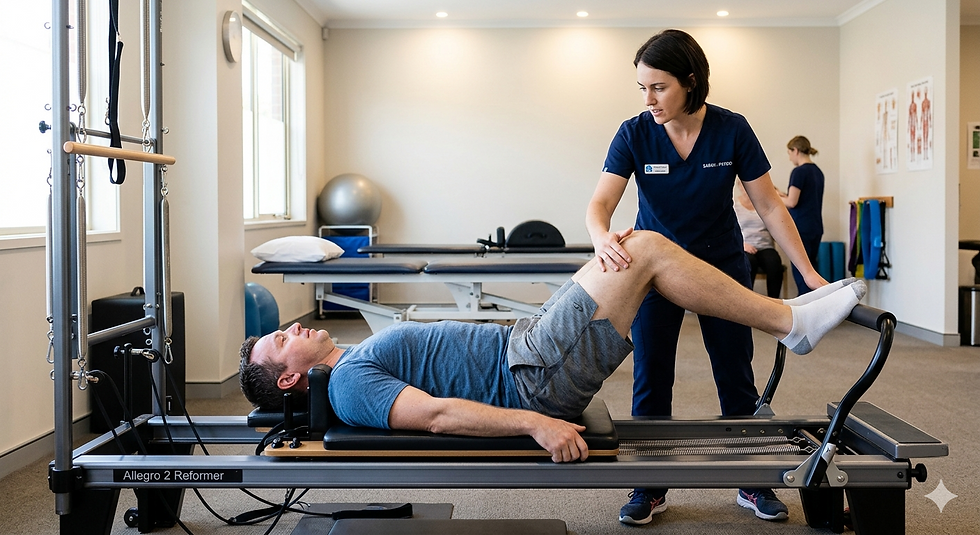
A physiotherapist can assess the hip joint, lumbar spine, strength, mobility and movement patterns to better determine what may be contributing.
Why Strength Training Can Improve Mobility
This sounds counterintuitive to many people.
If you’re stiff, shouldn’t you stretch?
Not necessarily.
Strength training performed through a large range of motion can improve both strength and mobility.
Think about a deep split squat.
You’re strengthening the legs while simultaneously taking the hip through considerable range.
A Romanian deadlift strengthens the posterior chain while loading the hamstrings through length.
A deep squat develops lower-limb strength while taking the hips, knees and ankles through greater ranges.
Rather than separating mobility and strength into completely different categories, we can often train both simultaneously.
This creates something incredibly useful:
Strength through range.
And for everyday function, that’s often far more valuable than simply being able to hold a passive stretch.
How Clinical Pilates Can Improve Hip
Mobility
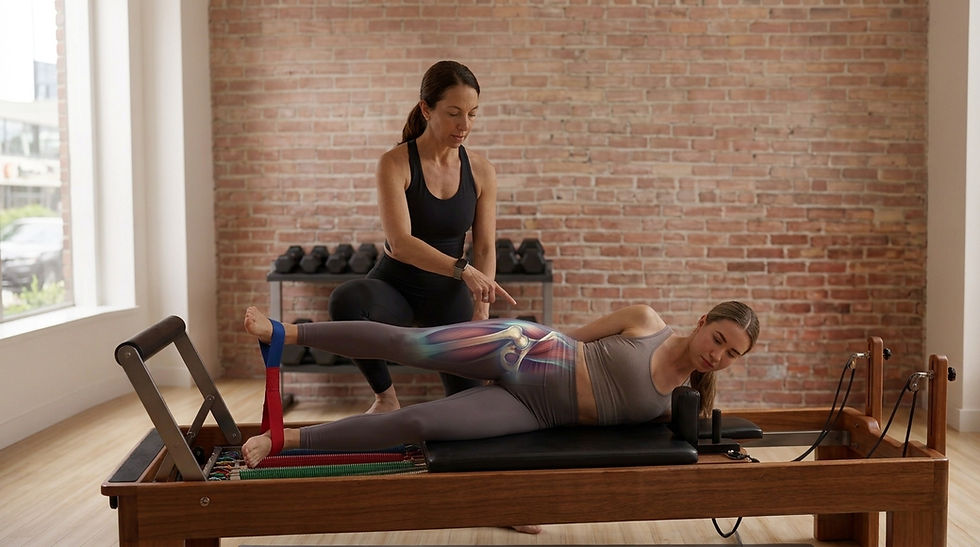
Clinical Pilates provides an excellent environment for developing both hip mobility and strength.
The equipment allows movements to be supported, assisted or resisted depending on what someone needs.
At Body Form, we might use Reformer, Trapeze Table, Wunda Chair and Spine Corrector exercises to work on:
hip flexion
hip extension
hip rotation
glute strength
hip flexor strength
adductor strength
single-leg control
pelvic stability
trunk strength
The important difference is that we’re not simply trying to make someone “more flexible”.
We’re trying to improve how effectively they can use and control their available movement.
Why We Combine Clinical Pilates With Strength Training
As your movement capacity improves, increasing resistance becomes important.
This is why our approach at Body Form incorporates both Clinical Pilates and strength training.
Pilates equipment gives us an excellent environment for developing movement quality and progressively challenging different positions.
Strength training then allows us to continue increasing the amount of force your muscles can produce and tolerate.
Together, these approaches can help create hips that aren’t simply flexible.
They’re strong, adaptable and capable.
That’s particularly important as we age.
Maintaining lower-limb strength and mobility supports your ability to:
walk
climb stairs
travel
get off the floor
exercise
play sport
maintain balance
remain independent
Mobility isn’t just about touching your toes.
It’s about maintaining access to the movements that allow you to live your life.
When Should Hip Stiffness Be Assessed?
Occasional stiffness after sitting or exercising is usually nothing to panic about.
However, it may be worth seeing a physiotherapist if:
stiffness is progressively worsening
you have persistent hip or groin pain
one hip has significantly less movement than the other
you’re experiencing night pain
you’re struggling to put shoes or socks on
walking is becoming uncomfortable
your symptoms are preventing you from exercising
you experience clicking, catching or locking associated with pain
you’ve been stretching consistently without improvement
An assessment can help determine whether the primary issue is mobility, strength, load tolerance, the hip joint itself, the lumbar spine or a combination of factors.
Practical Takeaways
If your hips constantly feel tight, don’t automatically assume you need to stretch more.
Remember:
Tightness is a sensation, not a diagnosis.
Sitting can make hips feel temporarily stiff without permanently shortening your muscles.
Passive flexibility and active mobility are different.
A joint needs strength and control throughout its available range.
Hip flexors don’t always need stretching sometimes they need strengthening.
Hip rotation is an important but frequently neglected component of mobility.
Strength training through a large range of motion can improve mobility.
Movement variety matters, particularly as we age.
Persistent or worsening hip stiffness should be properly assessed.
The goal isn’t to create the most flexible hips possible.
The goal is to create hips with enough mobility, strength and capacity to support the life you want to live.
Want To Improve Your Hip Mobility And Strength?
If your hips constantly feel stiff despite stretching, it may be time to look at what else is contributing.
At Body Form, our Physiotherapists and comprehensively trained instructors combine Clinical Pilates and progressive strength training to help clients improve mobility, build
strength and remain confident in their movement.
Rather than giving every client the same generic stretches, we look at what your body actually needs and progressively build from there.
Our small-group classes are capped at six clients, allowing our team to closely supervise technique and adapt exercises around your individual needs.
Body Form is located in Mona Vale on Sydney’s Northern Beaches, offering Physiotherapy, Clinical Pilates, strength classes, semi-private sessions and individual rehabilitation.
Contact our team to find the right starting option for you.


Comments