


Why Your Exercise Selection Matters Less Than Your Programming
Spend five minutes scrolling through social media and you’ll quickly come across instructors teaching “50 new Reformer exercises”, “10 creative footwork variations”, or “the one exercise your clients have never seen before.”
It’s easy to believe that becoming a better Pilates instructor simply means learning more exercises.
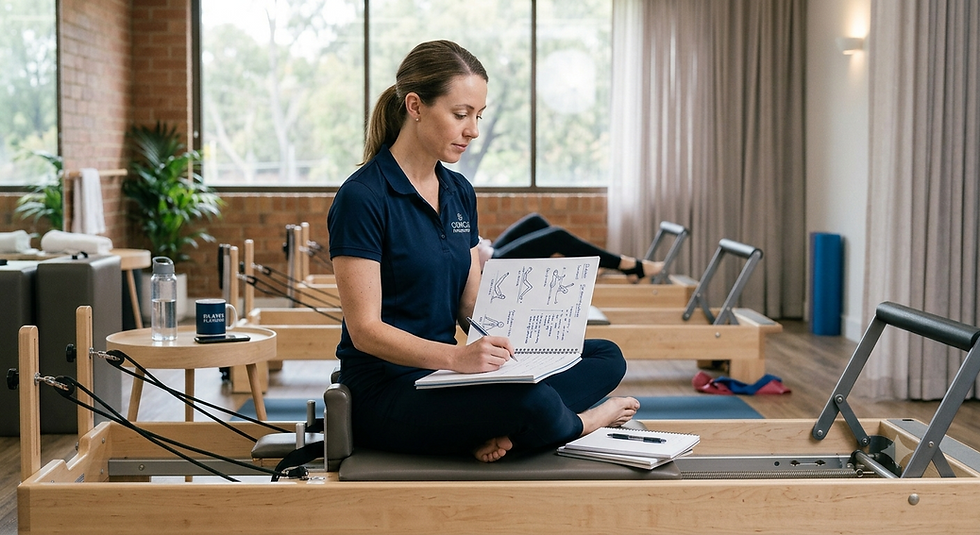
Many instructors spend years accumulating repertoire, attending workshops and saving
Instagram videos, convinced that expanding their exercise library is what will separate them from everyone else.
But here’s the reality:
The best Pilates instructors don’t necessarily know the most exercises.
They know how to programme.
They understand why they’re choosing an exercise, when it’s appropriate, how to progress it, and what adaptation they’re trying to create.
In fact, a well-programmed class using twenty familiar exercises will almost always produce better outcomes than a poorly structured class containing fifty creative ones.
Clients don’t pay you because you know unusual choreography.
They pay you because your programming consistently delivers results.
Exercises Are Just Tools
One of the biggest mindset shifts an instructor can make is understanding that exercises are simply tools.
No exercise is inherently good.
No exercise is inherently bad.
Every exercise has a purpose.
The question isn’t:
“Is this a good exercise?”
The better question is:
“Is this the right exercise for this client, today, for this goal?”
That single question transforms programming.
Because suddenly exercise selection becomes secondary.
The client’s needs become primary.
Great Programming Starts With An Outcome
Before selecting a single exercise, every instructor should know what adaptation they’re trying to create.
Are you trying to improve:
strength?
endurance?
motor control?
mobility?
confidence?
balance?
tendon capacity?
cardiovascular fitness?
Each goal requires a different programme.
Without a clear outcome, exercises simply become movement for movement’s sake.
More Exercises Doesn’t Mean Better Teaching
Many new instructors feel pressure to constantly introduce new exercises.
They worry clients will become bored.
The opposite is often true.
Clients don’t become stronger because they constantly experience novelty.
They become stronger because they progressively adapt to well-managed loading.
Imagine a personal trainer changing every gym exercise every single week.
Progress would be difficult to measure.
The same applies in Pilates.
Consistency creates adaptation.
Novelty creates entertainment.
They’re not the same thing.
The Variables That Matter More Than Exercise Choice
One of the biggest misconceptions in Pilates education is that changing the exercise creates progression.
Often it doesn’t.
The real programming variables are far more important.
Load
Perhaps the biggest variable of all.
Changing spring tension.
Adding resistance.
Reducing assistance.
Altering body weight demands.
The same Footwork exercise can become rehabilitation or heavy strength training simply by changing load.
Tempo
Movement speed dramatically changes the physiological stimulus.
A three-second eccentric creates a completely different adaptation from a fast repetition.
Tempo influences:
strength
motor control
time under tension
tendon loading
fatigue
Yet many instructors never intentionally programme it.
Repetitions And Volume
Ten repetitions performed close to fatigue create a different adaptation from thirty comfortable repetitions.
Volume should match the desired outcome.
More isn’t always better.
Better is better.
Rest
Recovery isn’t wasted time.
It’s part of the programme.
Clients cannot consistently produce quality movement if fatigue accumulates faster than recovery.
Programming appropriate rest improves performance.
Exercise Order
Order matters enormously.
Exercises performed early in a session occur when the nervous system is fresh.
Later exercises occur under fatigue.
If glute strength is your priority, placing demanding glute work after forty minutes of trunk fatigue may reduce training quality.
Sequence should reflect priorities.
Intent
Perhaps the most overlooked variable.
Two instructors can teach identical Footwork.
One asks clients to simply move the carriage.
The other cues:
“Drive through the floor.”
“Push the carriage away with intention.”
“Accelerate out, control back.”
The movement looks similar.
The training stimulus changes dramatically.
Programming Creates Adaptation
The body doesn’t recognise exercise names.
It responds to stimulus.
Your client doesn’t adapt because they performed Scooter.
They adapt because Scooter produced sufficient mechanical demand to stimulate change.
Understanding this shifts the instructor’s thinking.
Instead of asking:
“What exercise should I teach next?”
You begin asking:
“What stimulus does this client need?”
Common Programming Mistakes
Mistake 1: Too Much Variety
Clients rarely become proficient because every week brings an entirely new programme.
Learning requires repetition.
Progression requires familiarity.
Variation has value but only when it’s purposeful.
Mistake 2: Random Progressions
Sometimes classes become progressively harder simply because the instructor runs out of easier exercises.
Instead, progression should be planned.
Increase one variable at a time.
Perhaps:
more load
slower tempo
longer lever
greater stability demand
Not everything simultaneously.
Mistake 3: Chasing Fatigue
A sweaty client isn’t necessarily a stronger client.
Fatigue should never become the goal.
Adaptation should.
Sometimes reducing exercise volume while increasing quality produces significantly better outcomes.
Mistake 4: Programming Around Exercises Instead Of Clients
Great instructors don’t fall in love with exercises.
They fall in love with solving problems.
If an exercise no longer serves the client’s goals, it doesn’t belong in the programme.
No matter how much you personally enjoy teaching it.
Real Programming Example
Imagine three clients.
All perform Footwork.
The exercise name remains identical.
The programme doesn’t.
Client One
Recovering after ACL reconstruction.
Programming focuses on:
movement confidence
controlled range
moderate load
slower tempo
Client Two
Healthy 32-year-old wanting greater lower limb strength.
Programming focuses on:
heavier springs
fewer repetitions
higher force production
progressive overload
Client Three
72-year-old wanting better balance and independence.
Programming focuses on:
functional carryover
lower limb strength
controlled speed
confidence
gradual progression
Same exercise.
Three entirely different programmes.
That’s what programming looks like.
Great Instructors Think In Principles
Experienced instructors rarely ask:
“What exercise comes next?”
Instead, they ask:
“What quality am I trying to develop?”
“What is limiting this client?”
“What variable should I manipulate?”
Their thinking is guided by principles rather than choreography.
This makes their classes feel intentional.
Clients notice the difference.
Why Clients Keep Coming Back
Clients don’t usually remember exercise names.
They remember outcomes.
They remember feeling stronger.
Moving more confidently.
Having less pain.
Returning to running.
Playing with grandchildren.
Sleeping better.
Those outcomes aren’t created by novelty.
They’re created by thoughtful programming.
Professional Reflection
The Pilates industry has never had more exercises available than it does today.
Yet exercise libraries don’t create great instructors.
Clinical reasoning does.
Programming does.
Understanding adaptation does.
The instructor who can take ten familiar exercises and consistently produce meaningful change will always outperform the instructor who knows two hundred exercises but programmes randomly.
Because results are built through programming not choreography.
Continue Building Your Programming Skills
If you’d like to learn how physiotherapists programme Pilates differently, our Programming & Cueing Mastery Certification teaches the clinical reasoning behind effective programme design.
You’ll learn:
How to programme for different goals
Exercise sequencing
Load progression
Layering and regressions
Motor learning principles
Strength programming
Class planning frameworks
Practical cueing strategies
Designed specifically for Pilates instructors who want to move beyond memorising exercises and begin programming with confidence.
Available fully online and self-paced.
Key Teaching Points
Exercises are tools not the programme itself.
Programming begins with identifying the desired adaptation.
Load, tempo, volume and sequencing matter more than constantly changing exercises.
Clients adapt to stimulus, not choreography.
Great programming creates better long-term results than endless exercise variety.
The best instructors think in principles rather than repertoire.


Comments