


Why Every Pilates Instructor Should Understand Force (Even If You Never Studied Physics)
When most Pilates instructors think about improving their teaching, they focus on learning more exercises.
They attend another workshop.
They memorise another repertoire variation.
They add another prop.
While all of those things have value, they often overlook one of the biggest factors influencing every exercise they teach:
Force.

Every movement your client performs is governed by force.
The springs on the reformer create force.
Gravity creates force.
Body weight creates force.
Momentum creates force.
Even your cueing changes how force is distributed through the body.
The surprising part is that you don't need to become a physicist to understand it.
You simply need to understand how forces influence movement.
Once you do, exercises that once seemed complicated suddenly make sense.
Programming becomes easier.
Modifications become more logical.
And clients start progressing much faster because you're no longer teaching exercises—you're managing forces.
What Is Force?
In simple terms, force is anything that causes an object to move or changes how it moves.
Every time a client pushes the carriage away...
Pulls on a strap...
Stands on one leg...
Or lowers themselves into a squat...
Their body is responding to force.
Muscles exist to create force.
Bones transfer force.
Tendons transmit force.
Joints manage force.
Movement itself is simply the body's response to changing forces.
When instructors understand this, they stop thinking purely about muscles and begin thinking about what the body is actually trying to overcome.
Pilates Is Really About Managing Force
Joseph Pilates didn't create random exercises.
He designed equipment that changed how force acted on the body.
Take Footwork on the reformer.
At first glance it appears to be a simple leg exercise.
But biomechanically, the client is learning to:
produce force through the lower limbs
control force through the pelvis
transmit force through the trunk
resist force generated by the springs
decelerate force as the carriage returns
Understanding this completely changes how you teach it.
Instead of asking,
"Where should the feet go?"
You begin asking,
"Where is the force travelling?"
Gravity Is Always Working
One force instructors often forget is gravity.
Gravity never switches off.
Every exercise is either:
working with gravity
resisting gravity
or changing gravity's effect on the body.
This explains why the exact same movement can feel completely different simply by changing body position.
For example...
A leg lift performed lying on your side places a different demand on the hip than the same movement performed standing.
The muscle may be similar.
The force is completely different.
Likewise...
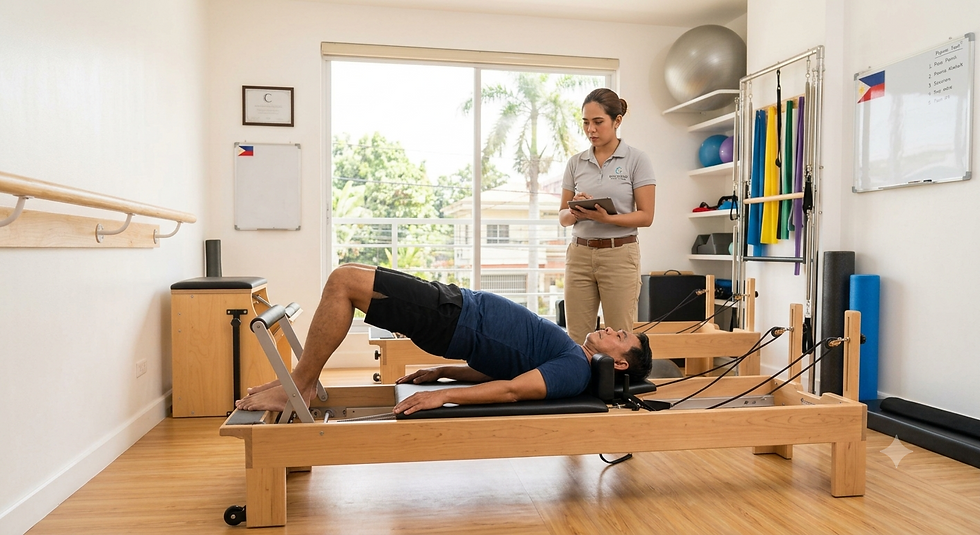
A bridge performed on the mat loads the body differently from a bridge performed on the reformer.
Not because the exercise has changed.
Because the forces have.
Why Springs Change Everything
Many instructors think springs simply make exercises harder or easier.
In reality, springs completely change the direction and magnitude of force.
Sometimes adding a heavier spring actually makes an exercise easier.
For example...
During Elephant, increasing spring tension may provide greater carriage stability, reducing the balance challenge.
Conversely, reducing spring tension may demand significantly greater trunk control.
Neither is universally better.
They're simply different force environments.
The same principle applies to:
Footwork
Scooter
Long Stretch
Side Splits
Standing Arm Series
Lunges
Rather than asking,
"How heavy should the spring be?"
Start asking,
"What force do I want the client to manage?"
Bigger Isn't Always Harder
One of the biggest misconceptions in Pilates programming is that larger movements automatically create greater challenge.
They don't.
Sometimes reducing range actually increases muscular demand.
Consider Shoulder Bridge.
Many instructors progressively increase bridge height.
But if a client loses pelvic control at the top of the movement, increasing range simply increases compensation.
A smaller range with better force control often creates a much greater strengthening stimulus.
Likewise...
Lowering the legs slightly during an abdominal exercise dramatically increases the moment arm acting on the trunk.
The movement looks almost identical.
The force demand changes enormously.
Why Lever Length Matters
Lever length is one of the simplest ways to change force.
Imagine holding a light dumbbell close to your chest.
Now hold the same weight with your arm fully extended.
The weight hasn't changed.
The force acting around the shoulder has increased significantly because the lever became longer.
Pilates uses this principle constantly.
Think about:
Tabletop versus straight legs.
Bent knees versus long legs.
Arms by the side versus arms overhead.
Short lever side plank versus full side plank.
The exercise hasn't fundamentally changed.
The force has.
Understanding lever length allows instructors to progress clients without constantly introducing completely new exercises.
Force Travels Through The Whole Body
One of the biggest mistakes new instructors make is assuming force stays where the movement occurs.
It doesn't.
Force travels.
A poorly controlled foot can change loading at the knee.
A stiff thoracic spine can increase loading at the shoulder.
Limited hip extension can increase force through the lumbar spine.
Everything is connected.
This is why clients often feel pain somewhere different from where the real problem exists.
The painful area is sometimes simply managing forces generated elsewhere.
Understanding this helps instructors stop chasing symptoms and begin improving movement quality globally.
The Goal Isn't Perfect Alignment
Many instructors become obsessed with achieving textbook alignment.
Neutral pelvis.
Perfect ribs.
Perfect shoulders.
Perfect feet.
While alignment certainly matters, the body isn't trying to achieve perfection.
It's trying to manage force efficiently.
Sometimes slight variations in alignment are entirely appropriate.
Sometimes they're the body's best available solution.
The important question isn't,
"Does it look perfect?"
It's,
"Can this client manage the forces involved safely and efficiently?"
That question creates much better coaching decisions.
Force Explains Why Clients Shake
Clients often apologise when they shake.
"I must be weak."
Not necessarily.
Shaking simply reflects the nervous system working hard to organise force production.
As muscles fatigue or face unfamiliar demands, motor units become increasingly active to maintain control.
Some shaking is entirely normal.
It often indicates that the exercise is providing an appropriate challenge.
The goal isn't eliminating shaking.
The goal is ensuring the client can continue producing quality movement while managing the required force.
Better Programming Through Force
When instructors understand force, progressions become much more intentional.
Instead of changing exercises every week, you can manipulate:
spring tension
body position
lever length
speed
stability
base of support
direction of movement
body orientation relative to gravity
Each of these changes the force experienced by the client.
That means one exercise can provide dozens of meaningful progressions without becoming repetitive.
Clinical Reasoning In Action
Imagine two clients performing lunges on the reformer.
One has Achilles tendinopathy.
The other has hip osteoarthritis.
They may appear to be doing exactly the same exercise.
But the force requirements should be completely different.
For the Achilles client, you may alter:
heel position
speed
calf loading
ankle range
For the hip client, you may instead adjust:
stride length
hip flexion angle
spring resistance
trunk position
The exercise name hasn't changed.
The programming has.
That's clinical reasoning.
Professional Reflection
The best Pilates instructors don't simply understand muscles.
They understand movement.
And movement is governed by force.
Once you begin thinking in terms of force instead of exercises, everything becomes simpler.
Exercises become tools rather than destinations.
Progressions become logical.
Modifications become purposeful.
Clients become easier to assess because you're asking better questions.
Instead of,
"What's the next exercise?"
You'll start asking,
"What force does this client need today?"
That one question can completely transform your teaching.
Continue Building Your Biomechanics Knowledge
Understanding force is one of the core principles covered inside our Applied Anatomy & Biomechanics Certification.
Designed specifically for Pilates instructors, the course bridges anatomy, biomechanics and real-world programming so you can confidently understand:
why exercises work
how forces change movement
why clients compensate
how to progress and regress exercises logically
how to coach using biomechanics rather than memorised cues
The course is fully online, self-paced and written by physiotherapists who teach these principles every day in clinical practice and teacher training.
Key Teaching Points
Every Pilates exercise is fundamentally an exercise in force management.
Gravity, springs and body position all influence movement demands.
Lever length often changes difficulty more than adding new exercises.
Bigger movement does not always mean greater challenge.
Force travels through the entire kinetic chain, not just the moving joint.
Understanding biomechanics allows instructors to progress exercises with intention rather than guesswork.


Comments