


Why Some Clients Never Feel Their Glutes (And Why Cueing Harder Doesn't Fix It)
"I just can't feel my glutes."
It's one of the most common comments Pilates instructors hear.
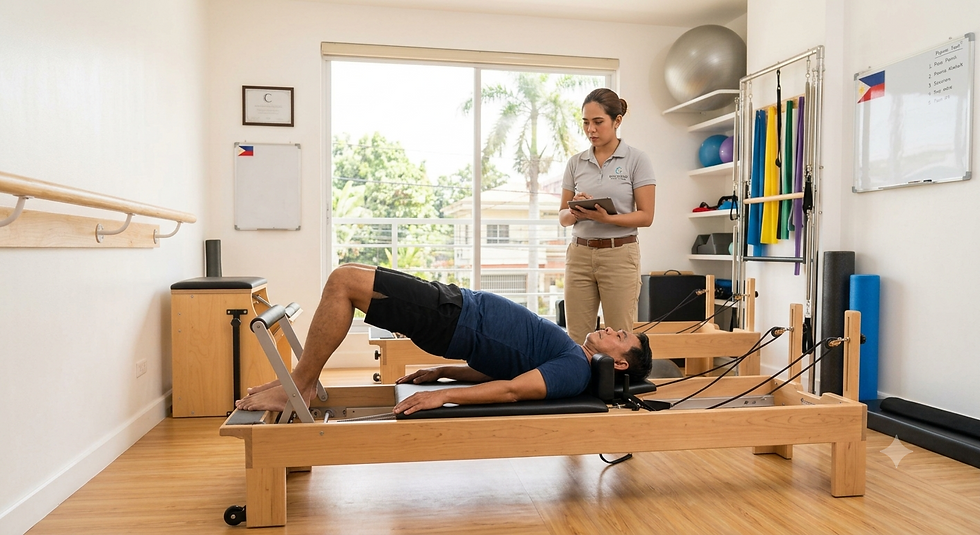
Sometimes it's during bridging.
Sometimes it's footwork on the reformer.
Sometimes it's lunges, scooter, standing leg press or side-lying work.
The instructor immediately responds with another cue.
"Squeeze harder."
"Engage your glutes."
"Use your bottom more."
The client tries again.
Still nothing.
So the instructor gives another cue.
Then another.
Eventually both instructor and client become frustrated.
The assumption is often that the client has "lazy glutes."
The reality is usually much more complex.
If you've ever found yourself repeating the same glute cue over and over with little success, the issue probably isn't your cueing.
It's your understanding of movement.
Helping clients recruit their glutes consistently requires an understanding of anatomy, biomechanics, motor control and load management not simply more verbal instructions.
Feeling A Muscle Isn't The Goal
Let's start with one of the biggest misconceptions in the fitness industry.
Clients often believe they need to feel a muscle working for it to be effective.
While internal awareness can sometimes be helpful, muscle soreness or a strong "burn" isn't proof that a muscle is working optimally.
Equally, not feeling a muscle doesn't necessarily mean it isn't contributing.
Electromyography (EMG) studies consistently show muscles can be highly active even when clients report very little awareness of them.
As instructors, our role isn't to chase sensation.
It's to improve movement.
Why "Squeeze Harder" Usually Doesn't Work
Imagine asking someone to smile harder when they don't understand the joke.
Or telling someone to relax when they're anxious.
The instruction isn't technically wrong.
It's simply not addressing the reason the behaviour is occurring.
The same thing happens with glute cueing.
If a client's nervous system isn't recruiting the glute effectively because of joint position, movement strategy or excessive compensation elsewhere, asking them to squeeze harder rarely changes anything.
It simply increases frustration.
Muscle Recruitment Is A Nervous System Problem
Movement begins in the brain.
Before a muscle contracts, the nervous system decides:
which muscles will contribute
how much they'll contribute
when they'll activate
how long they'll remain active
This process is called neuromuscular recruitment.
The body doesn't think in terms of individual muscles.
It thinks in terms of completing a movement.
If another muscle can complete the task more efficiently based on the client's current movement strategy, that's exactly what the nervous system will choose.
The goal isn't perfect muscle isolation.
The goal is efficient movement.
Why Clients Become Hip Flexor Dominant
One of the most common compensation strategies we see is hip flexor dominance.
The hip flexors become heavily involved in movements where we'd ideally like greater contribution from the gluteals.
This doesn't happen because the hip flexors are "bad."
It happens because the nervous system has learned that strategy over thousands of repetitions.
Contributing factors might include:
prolonged sitting
reduced hip extension mobility
poor lumbopelvic control
insufficient glute strength
movement habits developed over many years
Without changing these underlying factors, cueing alone rarely changes recruitment.
Hamstring Dominance During Bridging
Perhaps the most common example occurs during bridging.
The client immediately reports:
"I only feel my hamstrings."
The instinctive response is often to ask them to squeeze their glutes harder.
Instead, ask yourself:
Where are their feet positioned?
What is the angle of the knees?
Are they maintaining a neutral pelvis?
Are they achieving true hip extension?
Are they overusing lumbar extension?
Is the exercise appropriately loaded?
Small changes in setup often create much bigger changes than additional cueing.
Hip Position Changes Everything
The gluteus maximus is a powerful hip extensor and external rotator.
Its ability to generate force changes depending on the position of the hip.
For example:
A client attempting hip extension from excessive lumbar extension may struggle to recruit the glute efficiently.
A client beginning with excessive hip flexion may require a different strategy altogether.
The nervous system always chooses the easiest movement solution available.
Understanding biomechanics allows instructors to influence that solution through positioning rather than words.
Pelvic Position Matters More Than Most Instructors Realise
Pelvic position changes the length-tension relationship of many muscles around the hip.
An excessive anterior pelvic tilt may place the gluteus maximus in a mechanically disadvantaged position while increasing reliance on lumbar extensors and hamstrings.
Conversely, excessive posterior tilt can limit efficient hip extension altogether.
Rather than repeatedly cueing the glutes, improving pelvic organisation often creates better recruitment automatically.
Don't Forget The Feet
One of the most overlooked contributors to glute recruitment is foot pressure.
The foot is the body's first point of contact with the ground.
Changes in pressure distribution influence everything above it.
For example:
Poor tripod foot control can alter:
tibial rotation
femoral alignment
hip mechanics
pelvic control
By the time the movement reaches the glute, the body may already be compensating.
Sometimes improving foot awareness creates more effective glute recruitment than another twenty verbal cues.
Load Changes Recruitment
Another common mistake is trying to improve glute activation using exercises that simply aren't challenging enough.
Very low-load exercises have their place.
They can:
improve awareness
reduce fear
introduce movement patterns
But awareness alone doesn't create strength.
Once movement quality is established, the body needs progressive load.
This is where many instructors remain stuck.
Clients spend months performing activation drills without ever progressing to meaningful strengthening.
Eventually, adaptation plateaus.
When Activation Drills Actually Help
Activation drills aren't useless.
They're simply overused.
They are particularly valuable when:
introducing new movement patterns
helping clients understand body awareness
reducing apprehension following injury
preparing for higher-load exercises
teaching pelvic control
They should be viewed as preparation not the destination.
When Strengthening Becomes More Important
If a client has demonstrated reasonable movement quality but continues struggling with capacity, the answer is often progressive strengthening.
Examples include:
heavier footwork
single-leg bridges
standing lunges
loaded hip hinges
step-ups
scooter progressions
standing leg press
resisted side-stepping
Strength changes what the nervous system trusts.
The stronger the system becomes, the more confidently it recruits those muscles during everyday movement.
Ask Better Coaching Questions
Rather than asking:
"Can you feel your glutes?"
Consider asking:
Does the movement feel controlled?
Where are you losing stability?
What changes when we adjust your foot position?
What happens if we reduce the range?
Does this feel easier or harder?
Which variation gives you the best quality movement?
These questions encourage observation rather than chasing sensation.
Programming Before Cueing
Perhaps the biggest takeaway is this:
Good programming solves problems before cueing has to.
If a client cannot recruit their glutes effectively in a complex standing exercise, perhaps the answer isn't another cue.
Perhaps they simply need a different exercise today.
Or a different load.
Or a different body position.
Or a different progression.
Programming decisions usually have a much greater impact than verbal instructions alone.
Professional Reflection
One of the biggest shifts instructors make as they become more experienced is moving
away from coaching muscles and towards coaching movement.
Instead of asking:
"How do I get this client to feel their glutes?"
They begin asking:
"Why has this client's nervous system chosen a different movement strategy?"
That question changes everything.
It moves the conversation from simplistic cueing to genuine clinical reasoning.
And that's where confident, evidence-informed Pilates instruction begins.
Continue Your Professional Development
Understanding why clients recruit certain muscles and why they compensate with
others is one of the foundations of confident Pilates teaching.
Our Applied Anatomy & Biomechanics Certification was designed specifically to bridge the gap between learning muscle names and understanding how the body actually moves.
Rather than memorising origins and insertions, you'll learn how anatomy influences movement quality, compensation patterns, cueing decisions, exercise selection and programming across both Mat and Reformer Pilates.
If you've ever wondered why some clients simply don't respond to traditional cueing, this course will completely change the way you teach.
Key Teaching Points
Feeling a muscle isn't the same as recruiting it effectively.
Neuromuscular recruitment is determined by the nervous system, not verbal cueing alone.
Hip position, pelvic position and foot mechanics all influence glute recruitment.
Activation drills have a role but should progress into meaningful strengthening.
Better programming usually produces better muscle recruitment than more cueing.
Understanding biomechanics allows instructors to coach movement rather than simply chasing muscle sensation.


Comments