


Why Clinical Pilates is the Gold Standard for Long-Term Injury Prevention
- theziblingsalipoon
- Mar 24
- 3 min read
In the world of modern movement, there is a significant difference between simply exercising and moving with clinical intent. As a senior physiotherapist, I often see clients who have "tried everything" to manage recurring niggles or chronic stiffness, only to find that their symptoms return the moment they stop their routine.

The missing link is usually a lack of evidence-based, biomechanical focus. Clinical Pilates services bridge the gap between acute rehabilitation and everyday fitness. By focusing on how your unique body loads joints and recruits muscle, we move away from generic "core work" and toward a sophisticated, physio-led approach to injury prevention that actually lasts.
The Shift from Choreography to Clinical Reasoning
Traditional Pilates is a wonderful tool for general fitness, but injury prevention requires a deeper level of assessment. When Pilates is physio-informed, every movement is chosen based on clinical reasoning rather than just following a set sequence or choreography.
Understanding Load Management
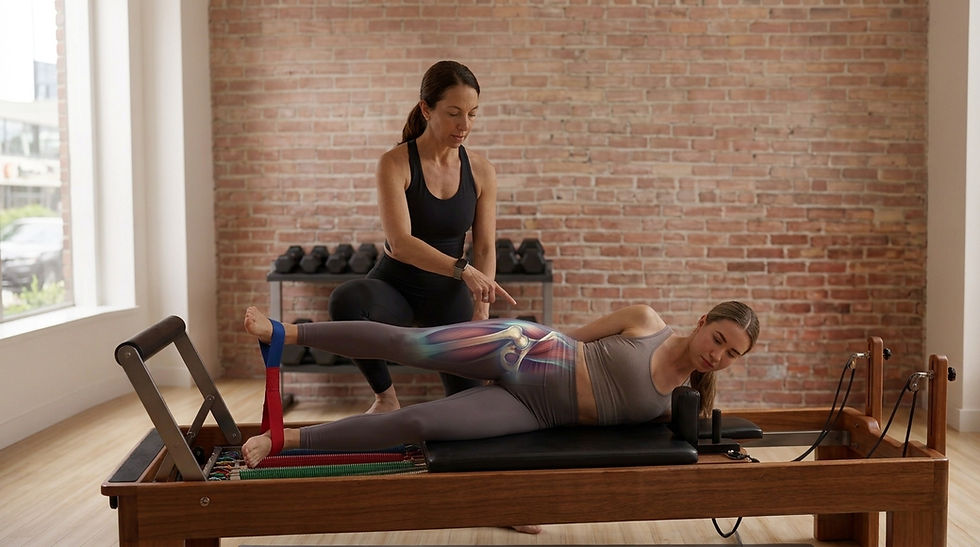
Injury often occurs when the "load" placed on a tissue (muscle, tendon, or joint) exceeds its "capacity." A senior physiotherapist uses Pilates equipment, like the Reformer or Trapeze Table, to precisely graduate this load. This allows us to:
Isolate weak links: Identifying specific muscles that aren't "firing" during complex movements.
De-load sensitive structures: Using spring resistance to support a joint while we strengthen the surrounding tissue.
Build progressive resilience: Slowly increasing the challenge to prepare your body for the demands of daily life or sport.
Identifying Compensation Patterns
The human body is an expert at finding the path of least resistance. If your hip is stiff, your lower back might move more to compensate. Over thousands of repetitions, these "short cuts" lead to overuse injuries.
Our Physiotherapy services focus on identifying these subtle compensation patterns. In a studio setting, we use Pilates to "re-train" the brain and body to move more efficiently. This isn't just about getting stronger; it’s about moving better.
Why Consistency and Supervision Matter
Safety in movement is not just about the exercise you do, but how you do it. Under the guidance of a professional who understands pathology and biomechanics, Pilates classes become a controlled environment for testing your physical limits without the risk of flare-ups.
Education is a core pillar of our approach. When you understand why you are performing a specific pelvic stability drill or a scapular control exercise, you are far more likely to carry those healthy movement habits into your life outside the studio.
Practical Takeaways
Assessment First: Effective injury prevention starts with a thorough understanding of your current physical state and history.
Quality over Intensity: One perfectly executed repetition with correct biomechanics is more valuable for injury prevention than twenty repetitions with poor form.
Specificity is Key: Your "prehab" routine should be tailored to your specific lifestyle, whether you are a desk-based professional or a weekend athlete.
The Power of Springs: Utilizing Reformer and Studio Equipment allows for eccentric strengthening (strengthening while the muscle lengthens), which is highly effective for tendon health and injury resilience.
If you have been managing a persistent issue or simply want to ensure your body remains resilient as you age, focusing on evidence-based movement is a proactive step forward. Understanding how your body moves today is the best way to protect how you move tomorrow.


Comments