


Reformer Pilates or Mat Pilates: Which Is Better for Rehabilitation?
When people begin exploring Pilates for injury recovery or rehabilitation, one of the most common questions is whether to choose reformer or mat. It is a reasonable question. The two formats look and feel very different, and in a rehabilitation setting the distinction matters more than most people realise.

The truthful answer is that neither format is universally superior. The right choice depends entirely on your body, your injury, your goals, and where you are in your recovery. Understanding how each format works will help you ask better questions, make more informed decisions, and get considerably more out of every session you attend.
At Body Form, we use both reformer and mat Pilates as part of our clinical approach to rehabilitation. Our physiotherapy background means every decision about which format to use, and when, is made on the basis of clinical reasoning rather than preference or trend.
What Is Reformer Pilates?
The reformer is an apparatus that uses spring resistance to provide support and variable load across a wide range of exercises and body positions. The sliding carriage, foot bar, and adjustable spring system make it possible to perform exercises in lying, seated, kneeling, and standing positions, each with varying degrees of support and challenge.
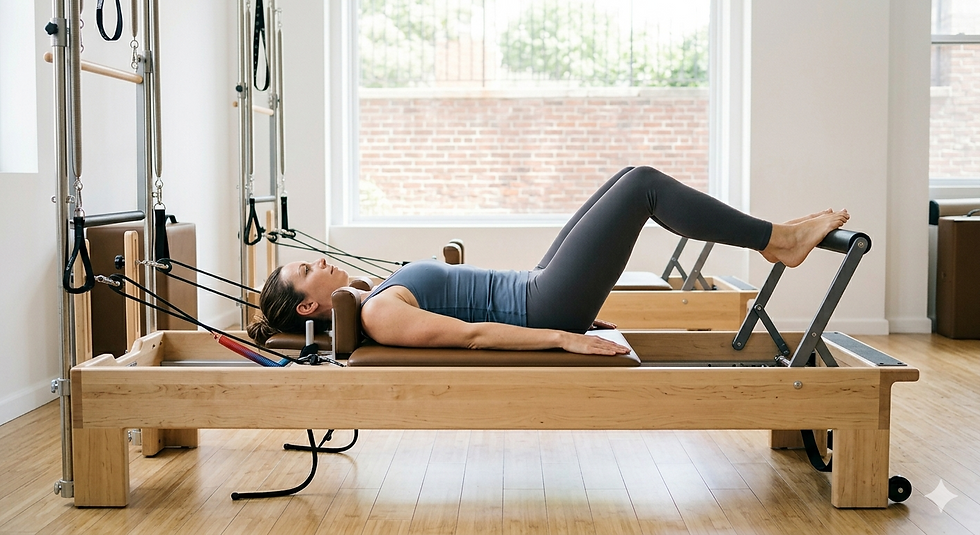
For rehabilitation, the reformer has a particular advantage: the ability to vary load and range of motion with great precision. Spring resistance can be increased to add a strengthening demand or decreased to assist movement that would otherwise be difficult or painful. This adjustability makes the reformer well suited to working with people who are in the earlier stages of recovery or who have significant movement restrictions.
In a rehabilitation context, the reformer tends to be most useful for:
Supported lower limb rehabilitation, including hip, knee, and ankle conditions
Graded loading in a horizontal position before progressing to standing exercises
Exercises that require controlled range of motion in the spine and hips
Clients who need significant support before they can tolerate full body weight through a joint or limb
Postoperative rehabilitation where precision and external support are important in the early stages
What Is Mat Pilates?
Mat Pilates uses the weight of your own body as the primary source of load and challenge. Without the spring assistance of a reformer, the body must generate its own stability and control to perform each exercise. This makes mat Pilates, in many respects, a more demanding environment for the nervous system and for the muscles responsible for coordinating movement.
In a rehabilitation context, mat Pilates is valuable because it develops functional strength in positions that more closely mirror the demands of daily life. The absence of external support means the body must learn to coordinate and stabilise independently, which is ultimately what we need for everyday movement and long term physical resilience.
Mat Pilates tends to be most useful for:
Building body awareness and breath connection in the early stages of rehabilitation
Developing core control and spinal stability without the variables of spring resistance
Progressing toward more functional movement patterns and independence
Clients who have established foundational control and are ready for a greater self generated challenge
Which Format Is Better for Rehabilitation?
The most honest answer is: neither, and both. The most effective rehabilitation programs tend to use elements of both formats depending on what the body needs at each stage of recovery.
A person recovering from knee surgery, for example, might begin on the reformer because it allows loaded lower limb work in a supported, non weight bearing position. As their capacity improves, mat exercises that develop single leg control and functional stability would be introduced. Someone working through a lower back condition might start with mat work to establish breath connection and basic spinal awareness, then move to the reformer for graded hip and leg loading once control is established.
In a clinical setting, the choice between reformer and mat is never made in isolation. It is always made in relation to:
What tissues are involved and at what stage of healing they currently are
What movement patterns need to be restored or retrained
What load the body can manage at this particular point in time
What functional goals the person is working toward
What to Look for in a Rehabilitation Pilates Program
If you are exploring Pilates for injury recovery, the following questions are worth asking before you commit to a program:
Is the program individually designed for your condition? Or does everyone in the class do the same exercises regardless of their presenting issues?
Is there an assessment process before you begin? A clinical setting will always assess first and program second. If you are guided straight to a class without any assessment, that is a useful piece of information.
Does the instructor have physiotherapy training or a background in injury management? A general Pilates qualification equips instructors to teach healthy adults. Working safely and effectively with injury requires additional clinical knowledge.
Are exercises progressed based on your response? Or do you repeat the same program week after week? Progression should be informed by how your body is adapting, not by a calendar.
Practical Takeaways
Reformer and mat Pilates serve different purposes at different stages of rehabilitation. Neither is inherently superior to the other.
The reformer is particularly effective at providing support and precisely graded load, making it useful in early to mid stages of recovery.
Mat Pilates develops independent stability and functional strength and is a valuable component of later stage rehabilitation and ongoing maintenance.
A physiotherapy informed program will use both formats at the right time, with decisions driven by clinical reasoning rather than resource availability or instructor preference.
If you are unsure which format is right for you, begin with an assessment from a physiotherapist who can make that decision based on your specific presentation and goals.
Find Out What Your Body Needs
At Body Form, we offer both reformer and mat clinical Pilates as part of a comprehensive approach to rehabilitation. Every program is informed by physiotherapy expertise and designed around the individual, not a class template.
If you are recovering from an injury and want guidance on the most effective path forward, contact our team or visit our website to learn more about what we offer and how to get started.

Comments