


Pilates vs Clinical Pilates: What Is the Difference?
If you have ever searched for Pilates classes in Sydney and found yourself confused by the terms on offer, you are not alone. "Pilates," "clinical Pilates," "reformer Pilates," and "Pilates led by a physiotherapist" all appear in search results, often without a clear explanation of what sets them apart. Understanding the difference matters, particularly if you are recovering from an injury, managing a chronic condition, or navigating the postnatal period.

This article draws on physiotherapy principles to explain what distinguishes clinical Pilates from general Pilates, and who is most likely to benefit from each approach.
What Is General Pilates?
General Pilates refers to group or studio-based classes led by a certified Pilates instructor. These instructors complete a recognised training program covering foundational exercises, cueing, and class structure. General Pilates is excellent for improving core strength, flexibility, body awareness, and overall fitness. Classes are typically designed for healthy adults and focus on movement quality, breath, and control.
Most general Pilates classes are not specifically designed to address pain, injury, or medical conditions. While a skilled instructor will offer modifications where needed, the class structure is not built around clinical reasoning or an individual assessment of your health history.
What Is Clinical Pilates?
Clinical Pilates is Pilates that is designed, supervised, or overseen by a qualified health professional, typically a physiotherapist. At Body Form Physiotherapy and Clinical Pilates, all classes are led or informed by a registered physiotherapist with specialist training in both rehabilitation and Pilates instruction.
The key differences come down to three things: assessment, individualisation, and clinical reasoning.
Before beginning clinical Pilates, clients undergo a thorough initial assessment. This allows the physiotherapist to understand your injury history, movement patterns, any diagnosed conditions, and your specific goals. The program is then designed around what your body actually needs, not what the average healthy adult might benefit from.
Why Assessment Changes Everything
In a general Pilates class, the instructor typically works with what they observe during class. In a clinical setting, your Pilates program is informed by a detailed understanding of your history. If you have had a spinal fusion, a pelvic floor concern, or a rotator cuff repair, your program is built with those factors considered from the outset.
This is not about making every session medically complex. It is about ensuring that the way you move, load, and progress is appropriate for your body. Clinical Pilates bridges the gap between rehabilitation and fitness in a way that general Pilates does not set out to do.
Who Benefits Most from Clinical Pilates?
Clinical Pilates is particularly well suited to:
People recovering from surgery or musculoskeletal injury
Individuals managing chronic pain, including back pain, hip pain, or neck pain
Postnatal women, particularly those with pelvic floor concerns or diastasis recti
Pregnant clients seeking safe, appropriate movement guidance for each trimester
Older adults with osteoporosis or balance concerns
Anyone who has tried general Pilates and found it aggravated their symptoms
It is also valuable for people who want more confidence that their movement program is being overseen by someone with clinical training.
The Role of the Physiotherapist
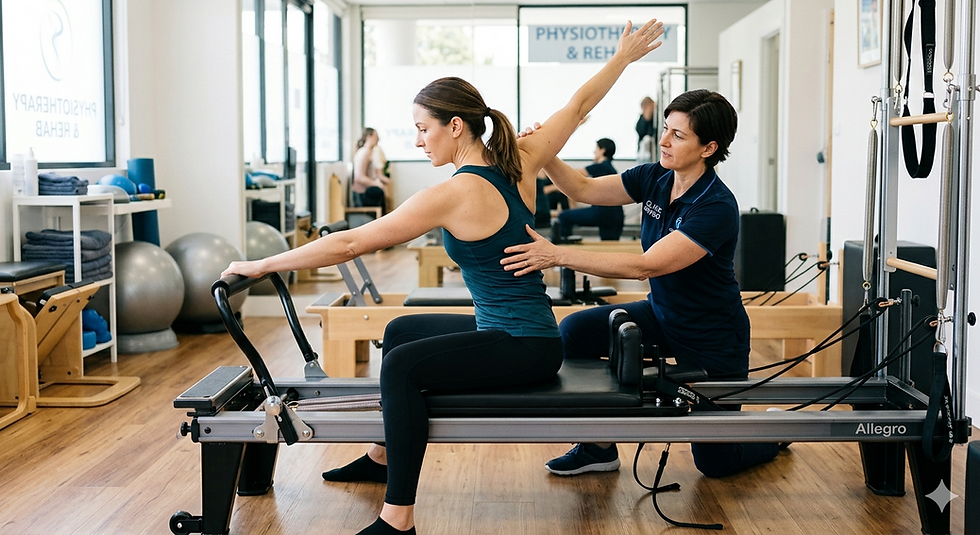
In a clinical Pilates setting, the physiotherapist is not just watching you move. They are applying clinical reasoning throughout each session. They understand load management, tissue healing timelines, pain science, and movement analysis. When your program is progressed, it is done so with a clear rationale, not simply because a certain number of weeks have passed.
This is the distinction that matters most. Any instructor can teach Pilates exercises. A physiotherapist understands why certain exercises are selected for your body, at this stage of your recovery or movement journey, in this specific loading position.
Can You Do Both?
Absolutely. Many clients begin with clinical Pilates during a period of recovery or for a specific health goal, then transition to general Pilates classes once they have a strong foundation and confidence in their movement. Others continue with clinical Pilates over the long term because they value the physiotherapy oversight and the smaller class sizes it involves.
At Body Form, our small group clinical Pilates sessions accommodate a maximum of six clients, ensuring each person receives genuine individual attention in every session.
Practical Takeaways
Clinical Pilates is led or supervised by a physiotherapist; general Pilates is led by a certified Pilates instructor
Clinical Pilates begins with an individual assessment and is tailored to your specific health history
It is particularly suited to people managing injury, chronic pain, postnatal recovery, or complex health conditions
You can move between clinical and general Pilates as your needs change over time
Smaller class sizes in clinical Pilates allow for more individual attention and appropriate load management
Ready to Find Out More?
If you are unsure whether clinical Pilates or general Pilates is right for you, a physiotherapy assessment is the clearest starting point. At Body Form, we are happy to help you work out which approach will best support your goals and keep you moving well.


Comments