Body Form® Education
Can I Become a Pilates Instructor Without Experience?
Yes. You do not need Pilates, fitness or teaching experience to start.
The short answer
Yes. No Experience Needed.
Written by Kira-Leigh Rule, Physiotherapist and Founder of Body Form® Education. Last updated 14 November 2026.
Yes, you can. Mat, Reformer and the Mat + Reformer Double Certification have no prerequisite, so you do not need a previous Pilates, anatomy, fitness or health-professional qualification. We start at the beginning with 17 online modules, then build you up to planning and teaching a full class. Expect professional study, physical practice, practice teaching and assessment: 250+ hours for one certification, completed within 8 months of access.
| At a glance | For a beginner |
|---|---|
| Prerequisite | None for Mat, Reformer, Mat + Reformer or the Full Comprehensive |
| Hours | 250+ for one certification, 365+ for Mat + Reformer, 450+ for the Full Comprehensive |
| Online theory | 17 modules, 136+ hours, self-paced |
| Practical training | 14 hours per discipline, in person with a local Master Trainer (Hybrid) or recorded practical training (Fully Online) |
| Apprenticeship | 70 hours per discipline: 10 observation, 30 self-practice and 30 practice teaching, which you organise |
| Assessments | 2 written programming and 2 practical teaching assessments per discipline, plus one online Final Theory Examination |
| Time | 8 months of access from enrolment. Many students finish between 4 and 6 months |
| How you study | Hybrid or Fully Online, with the same curriculum, assessments and qualification |
Before you start
What “No Experience” Really Means
It means there is no entry hurdle. It does not mean there is no work. This is professional teacher training, so you will study, move your own body, teach other people and be assessed.
Do I Need to Be Fit, Strong or Flexible?
No. Teaching is not a performance test. Your body size, strength, flexibility and injury history do not decide whether you can become an effective instructor.
You are assessed on planning, communicating, observing, managing and adapting a class, not on performing every advanced exercise.
What You Do Need
- Regular time each week across your 8 months of access
- People to practise teaching on: friends, family or community volunteers
- Access to the equipment for the certification you choose
- A willingness to learn, to practise and to take feedback
- Content, communication and assessments are all in English
Step by step
What a Beginner Learns, and in What Order
The theory comes first so that you arrive at your practical training knowing the language. The 17 modules are Physiotherapy-led, which means designed and directed by a Physiotherapist.
- 1
Online theory first
Start the 17 online modules the day you enrol. They begin with anatomy, then movement assessment, programming and cueing. You study at your own pace.
- 2
Practical training
Hybrid: practical days with a local Master Trainer, 14 hours per discipline, usually 2 to 3 days. Fully Online: recorded practical training and an exercise demonstration library.
- 3
Apprenticeship hours
70 hours per discipline, alongside everything else: 10 observing a qualified instructor, 30 taking classes yourself and 30 teaching other people.
- 4
Assessments
Two written and two practical per discipline, with written feedback. For each practical assessment you film a complete 45 to 50 minute class.
- 5
Final examination and certificate
One online Final Theory Examination of about 1.5 hours, then your Body Form® Education certificate once every requirement is passed.
The 17 Online Modules
- Foundations of Professional Pilates Teaching
- Anatomical Terminology and Body Systems
- Bones, Muscles, Joints, Ligaments and Tendons
- Range of Motion and Flexibility
- Spinal Anatomy, Core and Trunk Function
- Movement Assessment, Injuries and Exercise Modification
- Programming and Class Design
- Cueing and Communication
- Pregnancy and Postnatal Pilates
- Special Populations
- Breathing and Cardiopulmonary Function
- The Nervous System and Motor Control
- The History and Evolution of Pilates
- Building Your Pilates Career
- Client Care and Education
- Health, Safety and Professional Practice
- Customer Service and Business Skills
See the full curriculum and The Body Form® Method.
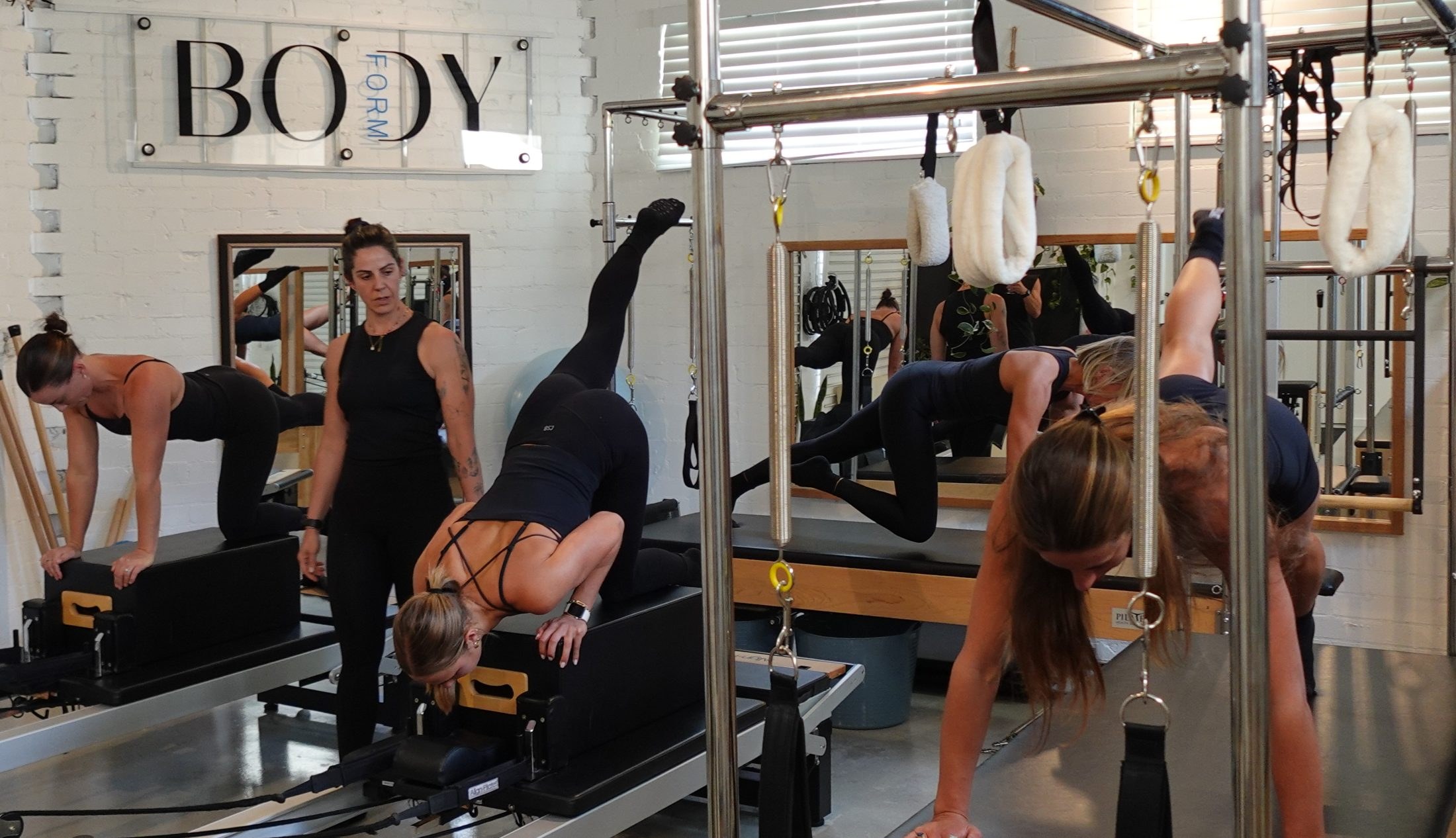
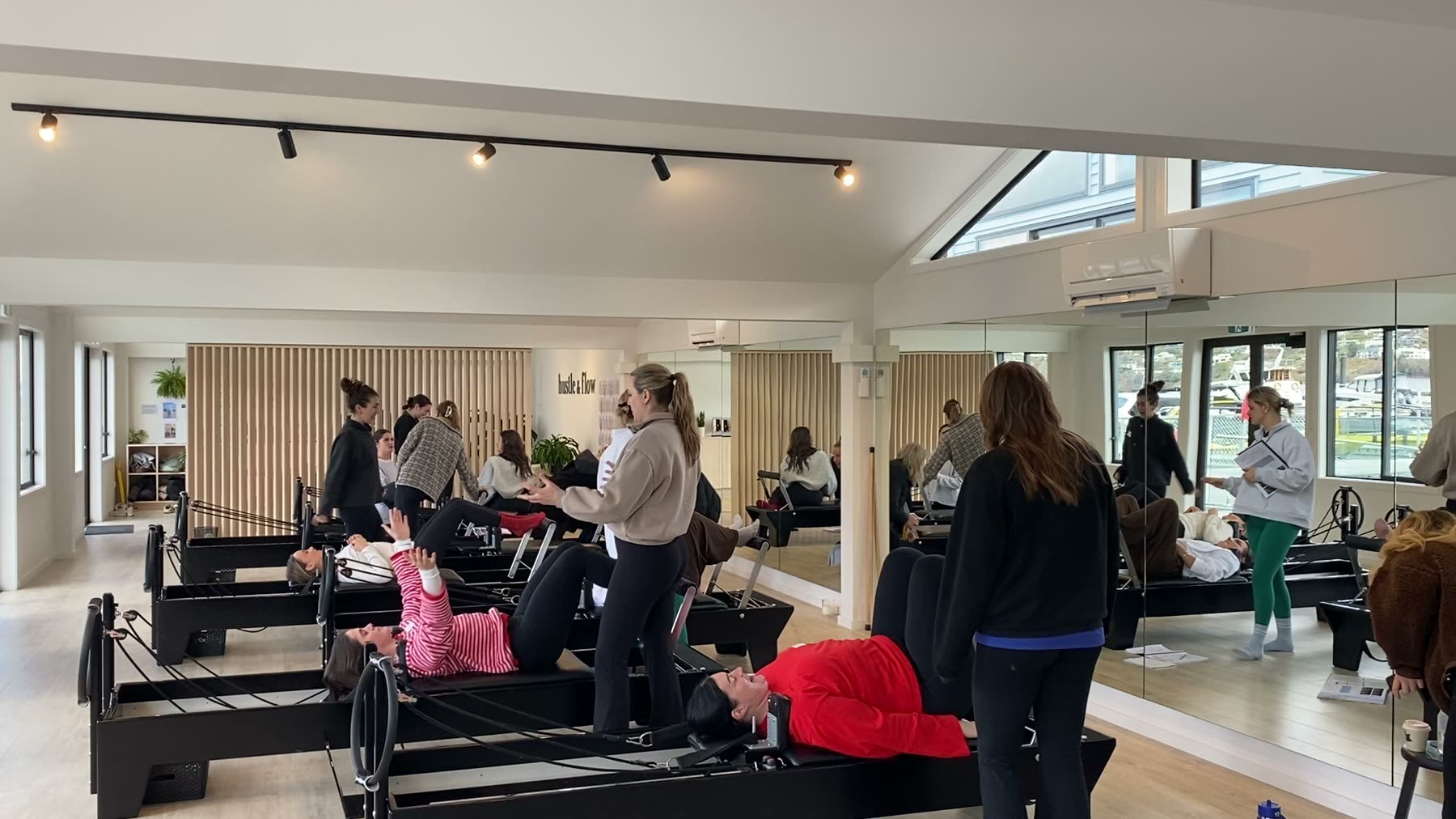
Practical days apply the theory instead of repeating lectures: your Master Trainer covers each exercise, then you teach it to a partner and get coached. Read what a practical day is like.
The Body Form® way
Knowing Pilates and teaching Pilatesare different skills.
Confidence
How to Build Confidence When You Are Brand New
You do not need to have taught before. This is what I recommend.
Learn a Little First
- We recommend working through the modules up to Programming & Cueing before practical days (it is needed to unlock the ability to submit your video assessments), but it is not compulsory before the practical days
- You arrive with the language and the anatomy, so the day is about applying it
Keep Your Equipment Simple
- Strong technique, programming, layering and modifications matter more than lots of props
- You do not need to buy everything at once
Use the Libraries Again and Again
- The exercise demonstration library and recorded practical training stay open for your whole 8 months
- Pause, rewind and watch as often as you need
Start Practice Teaching Early
- Practice teaching means actively instructing another person, not doing the exercises yourself
- Ask a friend or family member to be your first participant
- Teach within your current competence, get their consent and make sure the space is safe
Choose Where to Practise
- Pilates studios that accommodate student instructors
- Home or private settings with friends, family or volunteers
- Suitable community or private spaces
- For Reformer practice teaching you need access to a Reformer
- You do not have to complete hours at a Body Form host location
Log Your Hours as You Go
- 30 practice teaching hours per discipline, 60 for the Double
- Record them in your apprenticeship logbook
- Do them at your own pace, before or after your practical days, as long as they are complete before your certificate is awarded
Of the 70 apprentice hours, 10 are observation (up to 4 of those can be online) and 30 are self-practice, which means taking classes as a client, and that can be fully online.
Choosing a course
Mat First, Reformer First or Both?
Both are entry-level qualifications, and you choose the equipment you want to teach on. Reformer is a standalone qualification and Mat is not a prerequisite, so you can start with either.
Mat First
You learn the complete original repertoire from the Hundred to Control Balance, then go beyond it into functional, dynamic movement: planking, push, pull and lower-body strength, with props such as dumbbells. You practise teaching with a mat, some space and willing participants.
Reformer First
You learn the same teaching skills on the Reformer: spring selection, setups, footwork, box and trunk programming, standing lower-body work and the original repertoire from Up Stretch to Arabesque. You do not need to own a Reformer, but you need reliable access to one for practice teaching and assessments, through a studio, workplace, hire agreement or home studio.
Which Course Suits a Complete Beginner?
If you are new to Pilates, start with Mat, Reformer or the combined Mat + Reformer. Here are the courses with no prerequisite.
| Course | Total hours | Fully Online (pay in full) | In person (Hybrid), Australia |
|---|---|---|---|
| Mat | 250+ | AUD $2,350 | AUD $2,950 |
| Reformer | 250+ | AUD $2,350 | AUD $2,950 |
| Mat + Reformer Double Certification | 365+ | AUD $3,950 | AUD $4,950 |
| Full Comprehensive Clinical Pilates Teacher Training | 450+ | AUD $5,950 | Fully Online, with onsite training at selected locations |
AUD prices include GST for Australian buyers. There is no GST outside Australia. Prices outside Australia are set by location and are on the pricing page, with the payment plans and what tuition includes. Paying in full costs less than a plan. Read how much Pilates teacher training costs in Australia.
Can I Add the Second Certification Later?
Yes. You can upgrade a single Mat or Reformer certification to the Double, and you do not restart: completed coursework and assessments for that discipline still count. You complete the additional coursework, apprenticeship hours and assessments for the second discipline. Email the address you enrolled with, say whether you are doing Mat or Reformer, and Body Form® Education confirms the upgrade options and pricing.
Not sure yet? Ask yourself a few questions or read Choosing a course.
How you are assessed
Assessments in Plain Language
Assessment tests the work you are training to do: planning a class and teaching it to real people. It is the same whether you study Hybrid or Fully Online.
2 Written Programming Assessments
- Per discipline
- You write a complete 45 to 50 minute class plan
- It shows your sequencing, progressions and modifications
2 Practical Teaching Assessments
- Per discipline
- You teach that class to real people and film one continuous, unedited take of 45 to 50 minutes
- Assessment 1 needs at least 2 participants
- Assessment 2 is a new plan with at least 4 participants
Who Your Participants Are
- Family, friends or community volunteers
- They cannot be charged and they sign a waiver
- In Assessment 2 one represents a third-trimester pregnant client and one has a shoulder or back injury
What Is Marked
- Programming and exercise selection
- Cueing and teaching technique
- Modifications and class structure
- How well you apply what you have learnt
Feedback and Attempts
- You get written feedback on every assessment, and a Master Trainer marks within about two weeks
- You get three attempts at each assessment
- If an assessment needs more development, the feedback tells you what to improve
The Rest of the Checklist
- One online Final Theory Examination of about 1.5 hours
- Hybrid students have set assessment deadlines after the final practical day. Fully Online students have no individual deadlines
The full rules, filming requirements and deadlines are on the assessments and apprentice hours page.
How to study
Hybrid or Fully Online for a Beginner?
Both pathways use the same curriculum and assessment standards, and both earn the same qualification. The certificate is the same, and it does not show which pathway you studied. You have 8 months of access either way.
| Hybrid | Fully Online | |
|---|---|---|
| Practical training | 14 practical hours per discipline in person with a local Master Trainer, usually across 2 to 3 days. Equipment is provided on practical days. | Recorded practical training from real intakes, delivered by Kira-Leigh Rule, a Physiotherapist, plus an exercise demonstration library and recorded classes. You need access to the equipment for your certification. |
| Live classes | Scheduled practical days with 100% attendance required | No compulsory live classes. It is self-paced |
| Support | Your Master Trainer on the day and an intake WhatsApp group | The education team answers questions about content, apprenticeship, assessments and feedback. No scheduled one-on-one mentoring is included |
| Assessments | Deadlines are set after your final practical day, and both are passed within 12 weeks | You film yourself and submit through the student learning portal. No individual deadlines |
| Travel | To a host location. See Locations and Dates | None. Study from anywhere |
Choose Hybrid if you want hands-on feedback, a cohort and a local Master Trainer. Choose Fully Online if you live far from an intake or want to start today.
Hybrid vs Fully Online in detail and Fully Online teacher training.
Time
How Long Will It Take?
You have 8 months of access from enrolment, and it cannot be paused. Many students finish between 4 and 6 months. You graduate once every requirement is passed, so you can finish before your 8 months are up.
| Course | Total hours | About hours a week over 8 months |
|---|---|---|
| One certification (Mat or Reformer) | 250+ | About 7 hours |
| Mat + Reformer Double | 365+ | About 10 to 11 hours |
Eight months is about 35 weeks. If you finish in 4 to 6 months you will study more hours each week. No schedule guarantees a pass.
How long it takes to become a Pilates instructor and how the hours are built.
Before you enrol
What You Do Not Need
You do not need:
- A previous Pilates, anatomy, fitness or health-professional qualification
- Previous teaching experience
- To be fit, strong or flexible
- A studio of your own
- To buy every prop on day one
- To own a Reformer, only reliable access to one
- A Mat qualification before Reformer
- To finish all the modules before your practical days
- To travel, if you study Fully Online
The Props I Recommend for Your Own Practice
- A Pilates mat, the main essential
- A resistance band
- A small soft Pilates ball
- Light hand weights
- A Pilates ring
You can build these up gradually. For your filmed Mat assessment you need enough space to teach and film a complete 45 to 50 minute class, with props that suit your lesson plan.
What I Cannot Promise
I cannot promise you a job, an income, a visa, insurance cover or professional registration, and the rules differ by country and employer, so check what applies where you plan to teach.
Body Form education supports safe teaching and adaptation. It does not qualify graduates to diagnose, treat or provide clinical care.
Questions
Do I need any Pilates experience to enrol?
No. No previous Pilates, anatomy, fitness or health-professional qualification is required for entry-level Mat or Reformer teacher training, and the Mat + Reformer Double Certification and the Full Comprehensive have no prerequisite either. You should expect professional study, physical practice, practice teaching and assessment.
Is there a minimum age?
Students must be at least 16, and students under 18 need parent or guardian consent.
Do I need to be fit, strong or flexible?
No. Teaching is not a performance test. Your body size, strength, flexibility and injury history do not decide whether you can become an effective instructor. You are assessed on planning, communicating, observing, managing and adapting a class, not on performing every advanced exercise.
Can I start with Reformer, or do I need Mat first?
You can start with Reformer. Reformer is a standalone entry-level qualification and Mat is not a prerequisite. If you want both, the Mat + Reformer Double Certification covers both disciplines in one enrolment.
Which course should a complete beginner start with?
If you are new to Pilates, start with Mat, Reformer or the combined Mat + Reformer. Choose the equipment you want to teach on and check you can get regular access to it for practice teaching and assessments.
How long will it take me?
You have 8 months of access from enrolment, and many students finish between 4 and 6 months. Spread across the 8 months, one certification is about 7 hours a week and the Double is about 10 to 11 hours a week. You graduate once every requirement is passed.
Do I have to buy lots of equipment?
No. Keep your equipment simple while you learn. Strong technique, programming, layering and modifications matter more than lots of props, and a Pilates mat is the main essential. A resistance band, a small soft Pilates ball, light hand weights and a Pilates ring are helpful for your own practice.
Who do I practise teaching on, and where?
You organise your own practice teaching, with friends, family, volunteers or in a studio that accommodates student instructors. You do not have to complete your hours at a Body Form host location. Suitable places include Pilates studios that accommodate student instructors, home or private settings and suitable community or private spaces. For Reformer practice teaching you need access to a Reformer.
What if I do not pass an assessment the first time?
You get three attempts at each assessment, and you receive written feedback on what to improve. Enrolment does not guarantee graduation: you graduate once every requirement has been passed.
Accredited and Recognised
Body Form® Education teacher training is ITTAP accredited through the Pilates Method Alliance, mapped with AUSactive in Australia, and audited and verified by Pilates Aotearoa in New Zealand. This applies whether you complete Mat, Reformer or the full comprehensive pathway. Employment, insurance, visa and professional registration requirements vary by country and employer, so check the requirements where you plan to teach. CPD certifications are continuing education for qualified instructors.
Recognition and accreditation