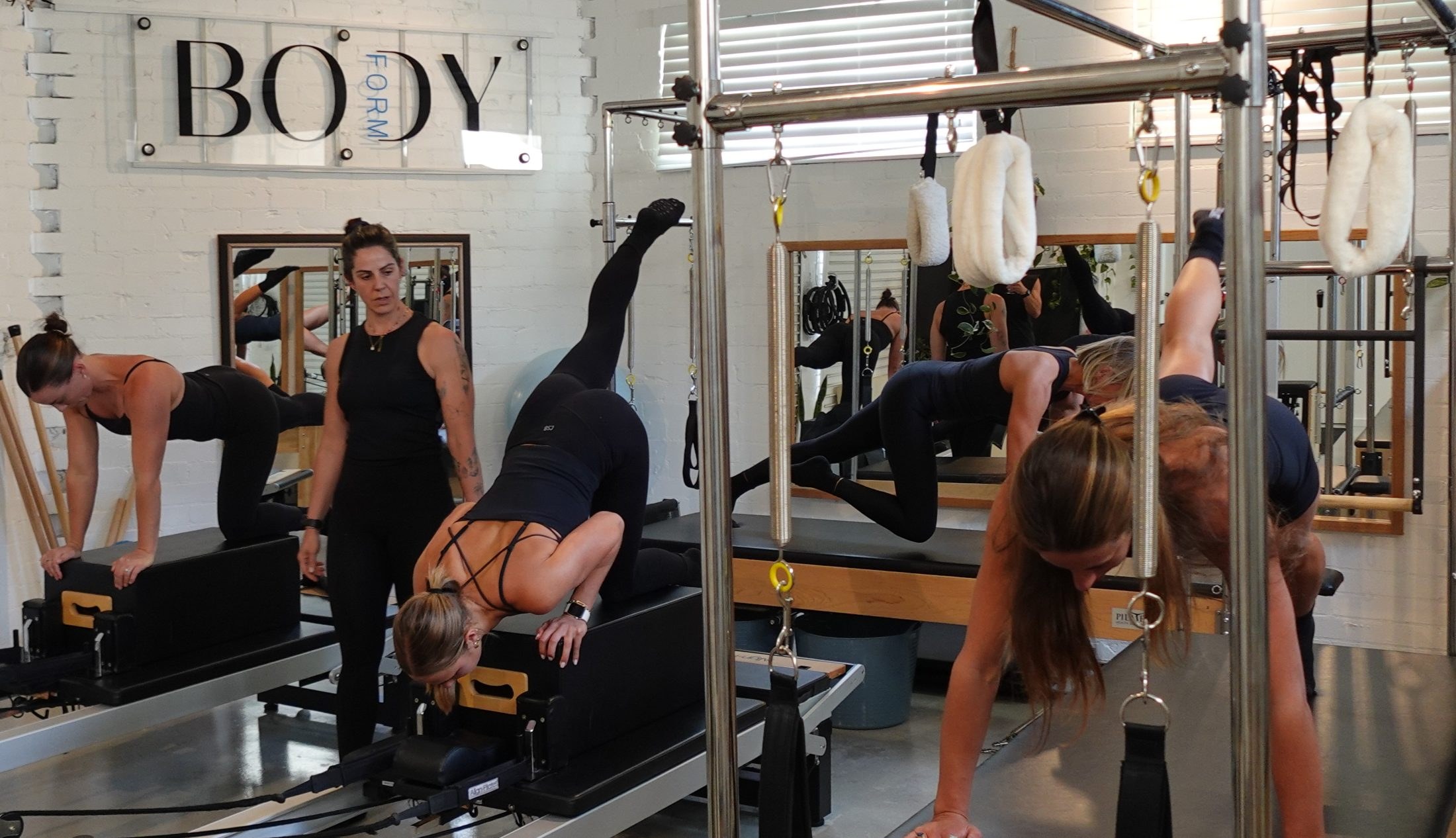
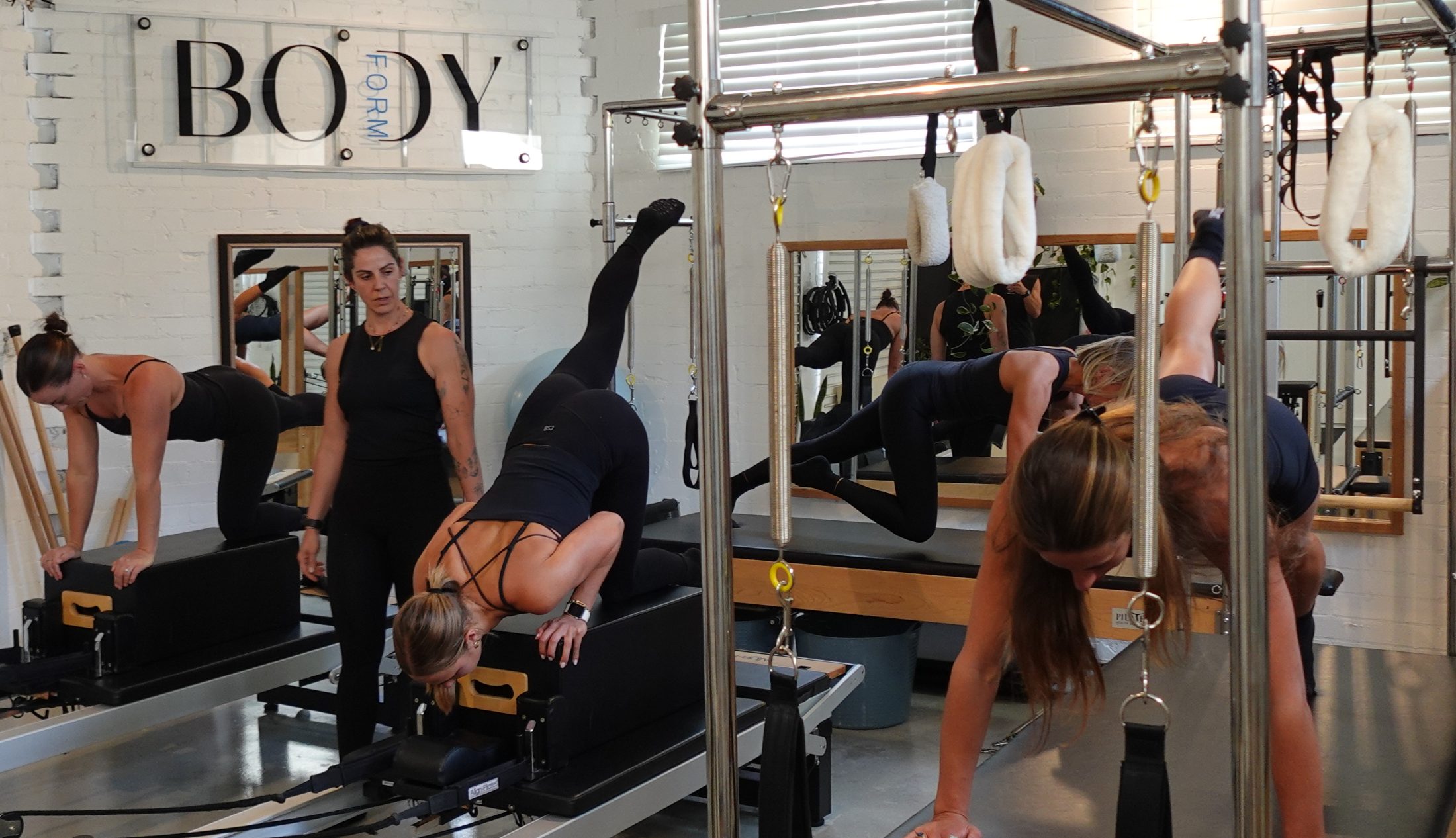
If a client develops pins and needles, numbness or an unusual radiating sensation during Pilates, stop the provoking movement and establish what has changed before deciding whether exercise can continue. The symptom might be temporary and position-related, but it can also indicate an issue requiring medical or Physiotherapy assessment. An instructor's responsibility is to recognise the change, respond appropriately and avoid diagnosing a “trapped nerve” from a single exercise response.
These situations appear in ordinary classes. A client may feel tingling in their fingers during a plank, notice numbness through a foot while standing on the Reformer or describe a sensation travelling down the back of a leg during straps work. Because the symptom may not be particularly painful, an instructor can underestimate its significance or decide that the person simply needs more stretching. Neither response is automatically appropriate.
What are pins and needles, and what do they tell us?
Pins and needles describes an altered sensation that may feel prickly, tingling or numb. Some people use words such as burning, electric or shooting. These descriptions can raise the possibility of nervous system involvement, but the sensation alone cannot identify a particular nerve or diagnosis.
The NHS page Pins and needles explains that temporary symptoms may occur when sustained pressure affects a nerve, often settling after a change in position. It also advises assessment when tingling is persistent or recurrent because other medical causes are possible. The Australian healthdirect resource Neuropathy: causes, symptoms and treatment similarly highlights numbness, tingling, weakness and coordination changes as symptoms worth discussing with a health professional.
A client might say their foot “fell asleep”, which can be a useful everyday description. As an instructor, you can acknowledge the sensation without concluding that it is harmless. How long it lasts, whether it repeatedly returns and whether it occurs alongside other symptoms all matter.
Why can neurological symptoms appear during movement?
The peripheral nerves carry sensory and motor information between the spinal cord and the tissues of the body. They travel through regions in which the positions of joints, muscles and surrounding structures change during movement.
Nerves can accommodate ordinary joint movement through changes in excursion and mechanical loading. In some clinical presentations, certain positions may reproduce or increase neural symptoms. Local pressure, nerve-root conditions and broader medical factors can also contribute. That does not mean every stretch that causes a strange sensation is stretching a nerve in a clinically meaningful way.
Consider a person with their hip flexed and knee extended during a supine leg movement. That position changes the mechanical relationship between several tissues, including hamstrings and neural structures. The client may feel an ordinary muscular stretch, or they may experience symptoms with a different distribution and quality. The instructor cannot separate those possibilities simply by watching the movement.
Similarly, tingling in the fingers during a plank might relate to sustained pressure at the wrist, positioning of the upper limb, a cervical presentation or another cause. The symptom is information to respond to, not a complete diagnosis.
What is the difference between muscular effort and neurological symptoms?
A local muscular burn during a demanding set is different from numbness or pins and needles, although clients do not always use precise terminology. Muscular fatigue commonly develops in the muscle groups doing the work and changes when the effort stops. A sensation that travels along a limb, affects skin sensitivity or produces numbness warrants a different line of enquiry.
That does not mean a burning sensation always indicates a nerve problem. Pain quality alone is not diagnostic, and some musculoskeletal symptoms are described as burning or sharp. It is the combination of symptom description, distribution, onset, associated changes and clinical assessment that becomes informative.
Ask the client what they mean in ordinary language. Is it a familiar muscle sensation, or do they feel tingling in the hand or foot? Did it occur before class? Has this happened elsewhere? Does it settle when the exercise stops? Is there any weakness or difficulty controlling the limb? These questions help with immediate teaching decisions; they are not a substitute for neurological testing.
What should you do immediately when a client reports tingling?
The first decision is straightforward: stop or remove the movement that is provoking the symptom. Ask the client to explain the location and quality of the sensation, whether it is new and whether it improves when the position changes.
If symptoms resolve promptly, there are no concerning associated features and the client has no medical restriction against exercise, you may be able to choose a different task that does not reproduce the symptom. This is a cautious teaching judgement, not confirmation of a benign cause.
If numbness persists, repeatedly returns, appears unexpectedly or is accompanied by weakness or reduced coordination, recommend appropriate clinical assessment. If symptoms are progressing or involve major neurological changes, do not continue the class as though changing the spring or lowering the legs has solved the underlying problem.
Document the exercise, the person's own description, the timing, your modification and the response. Avoid writing a diagnosis in your notes unless a qualified clinician has provided it.
Example: tingling in the fingers during a plank
Imagine a client performing a high plank with the wrists extended under body weight. Midway through the exercise, they report tingling in the fingers. The exercise involves sustained wrist extension and pressure through the hands, but that does not tell us which structure is involved.
A practical immediate response is to stop the plank and allow the client to change position. If the sensation settles and there are no other concerns, the instructor could choose a forearm plank, an elevated support or another exercise that develops trunk and shoulder strength without the provoking wrist position.
The most important detail is that the exercise modification serves the training objective. If the purpose was trunk endurance, there are several ways to challenge it without forcing prolonged wrist extension. If the person experiences repeated hand symptoms or grip weakness, however, a modified plank is not the endpoint of management. They should be assessed.
It would not be appropriate to tell the client their median nerve is trapped, that their upper trapezius is compressing the nerve or that stronger wrist muscles will resolve it. Those explanations require evidence that a Pilates class cannot provide.
Example: tingling down the leg during Reformer straps work
A client performs a supine legs-in-straps exercise. As their knees straighten and the legs lower, they describe tingling travelling into the calf. They may have no symptoms while the knees remain bent.
It would be tempting to label the sensation as tight hamstrings. But the distribution and quality could raise other possibilities, including neural involvement. The instructor's next step is not to push the legs lower to obtain a bigger stretch.
Instead, remove the provoking position, allow the symptoms to settle and review the client's history. A bent-knee variation or a different exercise may be a reasonable alternative when symptoms settle and there is no concerning presentation. A client with known neurological symptoms should ideally have a programme informed by the advice of their treating clinician.
The fact that bending the knees reduces symptoms does not prove that the sciatic nerve is the problem. Several anatomical demands change at once, including the length and loading of muscles and other tissues. This is a useful example of why modifying a movement is different from diagnosing it.
Example: numbness in a foot during standing Pilates
Standing exercises require reliable contact with the support surface and enough sensation and coordination to manage balance. If a client reports that one foot is numb during a standing Reformer exercise, continuing a balance-challenging task may be inappropriate even if the person does not describe pain.
You might stop the exercise, have the client step safely off the equipment and establish whether the symptom resolves. If they cannot reliably sense foot placement or report new weakness, they should not be encouraged to complete the remaining standing sequence.
The instructor can document what occurred and recommend assessment. A single change of footwear, spring or foot position does not establish the cause of numbness.
Should you stretch a nerve or teach nerve glides?
Some Physiotherapy programmes include neural mobilisation exercises. These are selected in relation to a clinical assessment and can involve controlled movement intended to change the mechanical interaction between neural tissues and surrounding structures.
They should not be treated as universal stretches. Aggressively moving into a position that reproduces tingling is not necessarily beneficial, and repeated symptom provocation can be inappropriate for some presentations.
It is also useful to distinguish a mobility exercise from a clinical neurodynamic test. A test may combine positions at several joints to explore symptom behaviour, but the result is interpreted alongside a clinical history and other examination findings. Instructors should not imitate a neurodynamic test, produce tingling and tell a client that they have identified a specific nerve entrapment.
An instructor can still teach ordinary movement appropriately. The boundary is crossed when they attempt to diagnose or prescribe a neurological intervention outside their training or scope.
How do nerve-root symptoms differ from local nerve symptoms?
A spinal nerve-root presentation, sometimes called radiculopathy when neurological impairment is involved, may produce symptoms travelling into the arm or leg. A local peripheral nerve condition may affect a more specific region, such as part of the hand. Patterns can overlap, and they are not always textbook-perfect.
It is therefore inaccurate to use a diagram of dermatomes or peripheral nerves to make a certain diagnosis in class. Even in clinical settings, symptom maps need to be considered alongside strength, sensation, reflexes and other findings.
The NSW Agency for Clinical Innovation's Acute low back pain guidance and the Australian Commission on Safety and Quality in Health Care's Low Back Pain Clinical Care Standard distinguish routine musculoskeletal presentations from those with alerting neurological signs. This is a useful reminder that the seriousness of a presentation is not determined by how painful it is. Progressive weakness or new changes in bladder and bowel function can matter far more than the person's pain score.
Which neurological symptoms require urgent action?
An instructor should know the warning signs that require immediate escalation rather than simply modifying an exercise.
Sudden weakness affecting one side of the body, facial drooping, speech disturbance or new severe neurological changes may indicate a medical emergency. In Australia, call 000 where appropriate.
New changes in bladder or bowel control, altered sensation around the genitals or saddle region, or significant or progressive weakness in the legs can indicate serious spinal pathology and require emergency medical assessment. Healthdirect's Sciatica and the NSW Agency for Clinical Innovation's emergency guidance identify these concerns explicitly.
Rapidly worsening neurological symptoms, major difficulty with walking or loss of function also require prompt medical review. Not every episode of tingling is an emergency, but a responsible instructor needs to recognise when the situation goes beyond a routine exercise modification.
If a client is unsure whether a symptom is concerning, encourage assessment rather than minimising it. Do not tell someone to finish the class and see whether the symptom disappears when there are warning signs.
Can someone with a nerve condition still do Pilates?
Often, yes. Many people with established neurological conditions or previously assessed nerve symptoms participate in exercise, provided the programme is appropriate for their presentation and follows relevant medical guidance. A diagnosis does not automatically mean all Pilates exercises are contraindicated.
The more useful questions are whether symptoms are stable, what the client has been advised, whether sensation or strength affects safety and what the exercise demands. A person with a medically assessed, stable condition might tolerate a broad range of loaded movements. Someone with newly developing neurological symptoms needs a different response.
A modification can adjust range, resistance, body position, support or the level of balance challenge. For example, a person who cannot tolerate a particular arm position may still be able to train the trunk or lower body effectively through another movement. But the capacity to modify an exercise should not be mistaken for competence to manage the medical condition itself.
How should you communicate with the client and their clinician?
A simple and factual description is more valuable than a confident but unsupported diagnosis. Rather than saying “your nerve is trapped”, explain that the reported tingling is not an expected muscle-fatigue response and that you cannot determine the cause in class.
If referral is appropriate, document the client's own words. For instance: “Client reported tingling in the thumb and index finger during high plank. The exercise stopped; tingling settled after position change. Client reports similar symptoms at home.” This is a hypothetical documentation example, not a record of an actual Body Form client.
That description gives the receiving clinician information about the task and symptom behaviour without prejudging the diagnosis. It also demonstrates appropriate professional communication.
Remember that not every client wants a lengthy anatomical explanation while they are concerned about a new symptom. Clear, calm communication is often more useful than overloading them with possibilities. Explain what you observed, why you are modifying or stopping the activity and what the next step should be.
How does this change your programming decisions?
Clinical reasoning in a group Pilates class involves recognising what you know and what you do not know. If the symptom is outside expected muscular effort, you need to respond. If a modification removes the provoking position, you still cannot conclude that the underlying condition has been identified. If the presentation has warning signs, the appropriate response is referral or emergency escalation, not exercise progression.
A good instructor can be confident without claiming clinical authority they do not possess. Understanding basic neuroanatomy helps you recognise why symptoms might change with movement, but professional competence also includes knowing when not to provide an explanation.
Body Form Education's current Advanced Injury Modification CPD and Applied Anatomy and Biomechanics CPD support instructors who want to strengthen the reasoning behind exercise selection and modifications. The objective is not to memorise a list of nerves and forbidden movements, but to teach thoughtfully and recognise when another professional needs to be involved.